
12 Tips to Win More Rounds in Paint Hide and Seek
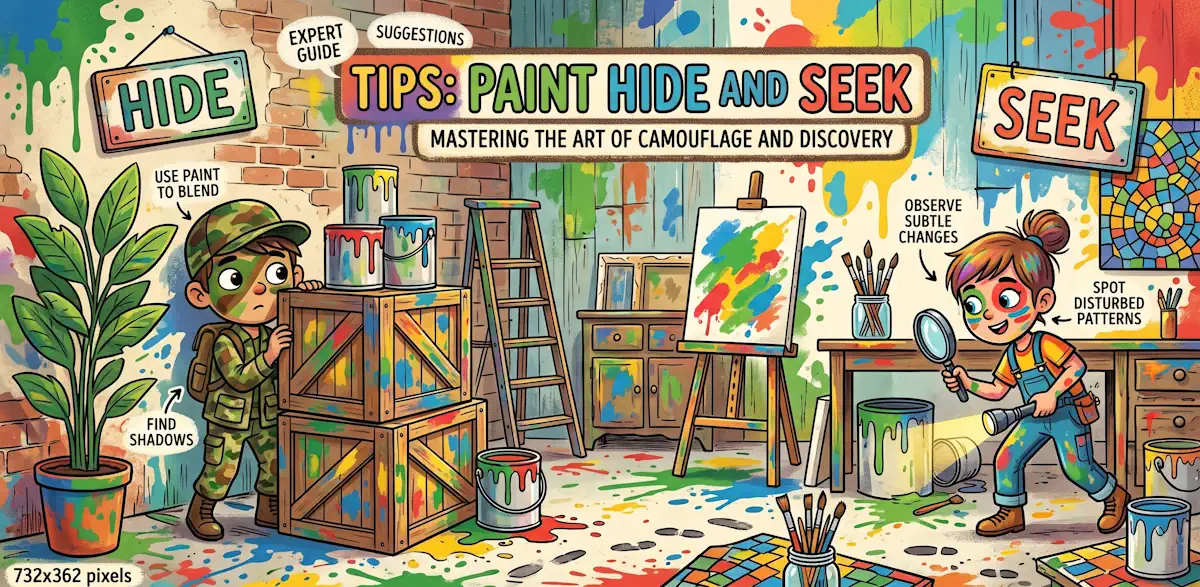
Painting yourself the right color is only half the battle. Players who consistently survive rounds treat hiding as a full package — spot, color, light, pose, and discipline — rather than a single lucky guess. Below are 12 practical tips split between Hider strategy and Seeker strategy, so no matter which role you're stuck with, you'll have an edge.
Hider Tips: How to Disappear
1. Budget Your Prep Time
The prep window always feels shorter than it is. Spend the first third locking in your hiding zone and sampling colors, then use whatever time is left to refine edges and lock your pose. Players who hold out looking for the "perfect" spot often end up half-painted when the hunt begins — and a half-painted hider is an easy tag.
2. Pick the Background Before the Paint
Good hiding starts before you even open the color tool. Look for busy, cluttered areas — stacked objects, repeating panels, messy corners — rather than a single flat wall. Clutter is forgiving: if your color match is slightly off, a busy background hides the difference. A blank wall, on the other hand, gives seekers a clean surface to scan and makes your outline stand out. Save flat surfaces for when your paint job is genuinely close to perfect.
3. Match the Light, Not Just the Color
Copying the right base color isn't enough on its own. Check where the light source in the room is coming from and shade your body accordingly — slightly brighter on the side facing the light, slightly darker on the side facing away. This one detail is often what separates a convincing hide from an obvious one.
4. Study the Map Before You Commit
Don't paint yourself at the first spot you see. Take a quick lap around the area first — the best hiding spots are usually the ones that aren't obvious at a glance, not the first corner you stumble into.
5. Think About Approach Angles
Seekers tend to enter rooms from predictable directions — doorways, hallways, main paths. Position yourself so your weakest angle isn't facing the most likely entry point.
6. Avoid Crowded Spots
If several other hiders picked the same corner, that corner becomes the first place seekers check. Spreading out across the map is almost always safer than clustering near the "best" spot.
7. Stay Still — Really Still
Small movements, even shifting your camera or view, can catch a seeker's eye instantly. Once your color and pose are locked in, commit to holding position no matter how close a seeker gets.
8. Plan Your Escape Route, But Don't Stare at It
If you're playing a mode where hiders can make a break for it, decide on an exit path in advance — but avoid visibly glancing toward it while a seeker is nearby. Looking at your escape route is one of the easiest tells that gives away an otherwise perfect hide.
9. Let Sloppy Hiders Work in Your Favor
A poorly disguised hider nearby isn't necessarily bad news. Seekers often go for the obvious target first, tag them, and move on satisfied — sometimes walking straight past a much better hiding spot on their way out. If someone else's camouflage is weak, staying exactly where you are can let their mistake buy you time.
Seeker Tips: How to Find Everyone Faster
10. Check Edges and Clutter First
Walls, corners, and cluttered furniture hide far more players than open floor space ever will. Start your search along edges and busy areas instead of scanning the middle of the room.
11. Look for Mismatched Light and Color
Since experienced hiders shade themselves to match the light source, look specifically for surfaces where the lighting looks slightly "off" compared to everything around it — that's often a giveaway even when the base color is a near-perfect match.
12. Use Sound and Voice Chat
Footsteps, hesitation, or other players reacting near a hidden teammate are often a giveaway before you spot anything visually. Don't rely on your eyes alone — your ears can narrow down a search area fast.
Master these fundamentals and you'll start winning rounds that used to feel like pure luck. The difference between surviving one round and surviving every round usually comes down to treating your hide as a complete package — not just a color, but a spot, a pose, and the discipline to stay frozen when every instinct says to move.
Frequently Asked Questions
What's the biggest mistake new hiders make?
Picking a flat, open wall because it looks like an "easy" color match. Open surfaces give seekers a clean outline to scan, while cluttered areas hide small imperfections in your paint job.
Does pose really matter, or is color enough?
Pose matters just as much as color in most paint hide and seek games. A great color match with an unnatural pose still looks out of place, while a slightly imperfect color paired with a convincing pose can easily fool a seeker.
Is it better to hide alone or near other players?
It depends. Hiding near a poorly camouflaged player can work in your favor, since seekers often tag the obvious target and move on. But hiding in a crowded "popular" spot with several well-hidden players increases the odds someone nearby gets spotted first, drawing extra attention to the area.